

 Share
Share 


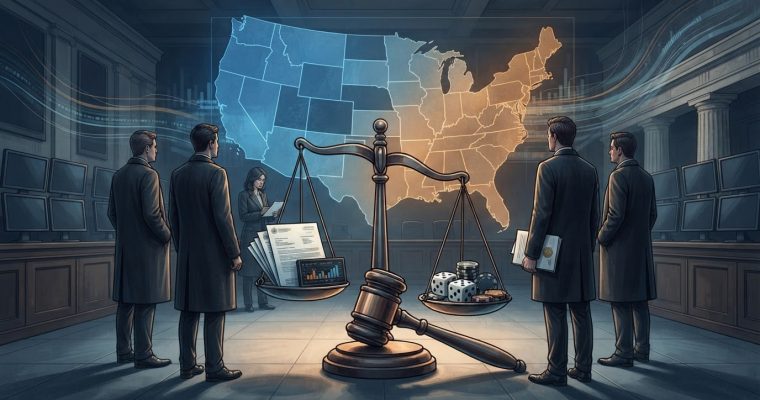
A growing split in federal courts is raising the stakes for prediction markets, with the Supreme Court now being asked to decide whether platforms such as Kalshi should operate under one federal rulebook or face state-by-state gambling enforcement.
The dispute matters because it could determine whether event contracts are treated more like federally regulated financial products or like betting activity that states can restrict under their own gambling laws.
Federal courts are split on who regulates event contracts
According to NetChoice, Congress gave the Commodity Futures Trading Commission exclusive jurisdiction over swaps traded on federally designated exchanges such as Kalshi. The article says the CFTC previously blocked election contracts, then changed course after a federal court ruled for Kalshi in 2024 and the agency later dropped its appeal.
Since then, courts have not spoken with one voice. The Third Circuit ruled that New Jersey cannot apply its gambling laws to Kalshi’s sports-event contracts. The Ninth Circuit, however, ruled that Nevada can apply its gambling laws, finding the contracts likely are not swaps under federal commodities law. The Sixth Circuit also ruled for Ohio and Tennessee, while a federal court in Chicago later blocked Illinois from applying its sports-wagering licensing rules to the same contracts.
That conflict has now reached the Supreme Court, after New Jersey asked the justices to settle the question.
Why supporters say prediction markets should be treated differently from sportsbooks
The NetChoice piece argues that prediction markets serve a different commercial function from sportsbooks. On an exchange, it says, the platform does not take the other side of every trade and instead facilitates trading between participants. A sportsbook, by contrast, sets the odds and takes the opposite side of each wager.
In the Illinois case, U.S. District Judge Martha Pacold wrote that “people may view these contracts as gambling, but little in the statutory definition turns on what people think. Instead, most of the definition turns on commercial function.”
The article also points to forecasting value. The University of Iowa has run election markets since 1988, and one comparison cited by NetChoice found that across five presidential elections, the Iowa market beat 964 polls about 74 percent of the time.
What to watch next
For players and industry watchers, the immediate issue is whether prediction markets keep moving toward a national regulatory model or get pushed into a fragmented system of state rules. NetChoice argues that state-by-state licensing would shrink trading pools and weaken forecast quality. For now, the key unresolved question is whether the Supreme Court will take the case and how it will classify these contracts.
—
Source: As reported by Bartlett Cleland.